| 🇦🇺 | Australia | |
| 🇳🇿 | New Zealand | |
| 🇺🇸 | United States | |
| 🇨🇦 | Canada | |
| 🇬🇧 | United Kingdom | |
| 🇮🇳 | India | |
| 🇿🇦 | South Africa | |
| 🇭🇰 | Hong Kong | |
| 🇵🇬 | Papua New Guinea |
A patented, engineered approach to farming medical-grade bioactive honey at industrial scale
The Opportunity
Medical-grade bioactive honey — the kind prized for its natural antimicrobial strength — has always been a matter of luck. It comes from specific plants like Leptospermum (the manuka and tea-tree family), and beekeepers have historically been at the mercy of wherever those plants happen to grow wild. Yields are inconsistent, seasons are short, and there has been no reliable way to engineer better outcomes.
This patent portfolio changes that. It covers a systematic, landscape-engineering approach to growing bioactive honey deliberately and predictably — turning what was once a wild-harvest product into a designed agricultural process.
The Core Innovation
The technology solves a problem beekeepers have long worked around: the very plants that produce bioactive nectar don’t provide enough protein-rich pollen to keep a colony healthy. Bees foraging exclusively on these plants can run low on the energy they need to make it back to the hive.
The invention’s answer is the “flora cell”, a deliberately designed foraging environment that plants two complementary populations together:
- A primary nectar species (such as Leptospermum) that yields bioactive honey
- A secondary nutrient species, positioned and spaced to keep foraging bees fed and able to return safely to the hive
Refinements across the portfolio add further control: staggering when each plant population flowers to extend the production season, and a predictive formula that lets an operator forecast bioactive yield before committing land and hives to a layout.
The Family of Patents
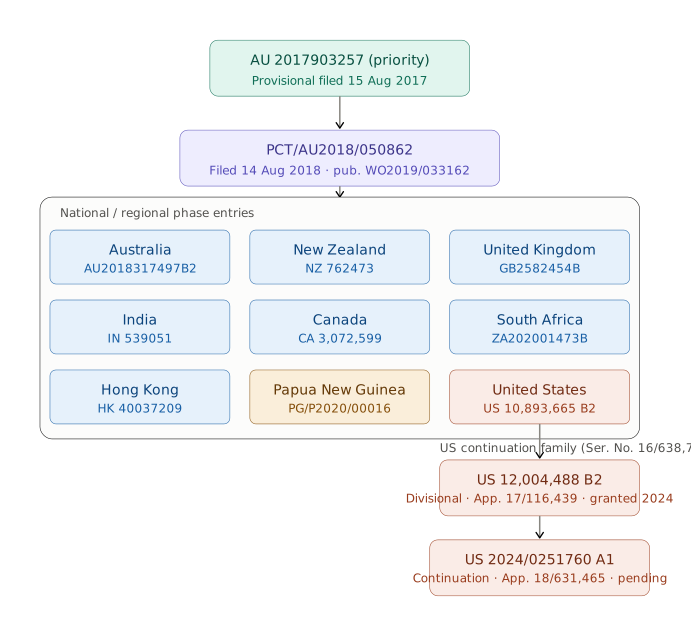
A Layered Portfolio
Rather than a single patent, this is a growing family of protection, with each filing covering a distinct commercial angle of the same core invention:
| Patent | Status | Protects |
|---|---|---|
| US 10,893,665 B2 | Granted (2021) | The physical hive-and-flora-cell environment, including remote placement of nutrient plants to extend safe foraging range. |
| US 12,004,488 B2 | Granted (2024) | The production method itself, including a predictive formula for forecasting bioactive honey yield from cell design. |
| US 2024/0251760 A1 | Granted (2026) | Staggered flowering-time coordination between nectar and nutrient plant populations to extend the production season. |
Why It Matters
- Predictability — replaces wild-harvest guesswork with an engineered, repeatable production system
- Scalability — designed from the outset for industrial-scale deployment, indoors or outdoors
- Extended season — staggered flowering design lengthens the productive window per site
- Defensible IP — layered protection spans the physical environment, the production method, and the seasonal technique, making the portfolio diffcult to design around
- Global priority — anchored to an original 2017 Australian filing, with international (PCT) coverage supporting the U.S. family
Get In Touch
This portfolio is available for licensing, partnership, or acquisition discussions. For more information on commercial terms, please reach out to the designated representative.
Mr Kevin Peter Ashby
Patent Attorney
This document is a summary prepared for promotional purposes and does not constitute legal advice. Refer to the full patent filings (US 10,893,665 B2; US 12,004,488 B2; US 2024/0251760 A1) for complete claim language and legal scope.